

An agentic-commerce landscape slide from Activant Research landed in my inbox with hundreds of logos packed into consumer shopping, retail, procurement, identity, fraud, payments, models, cloud, and payment infrastructure.
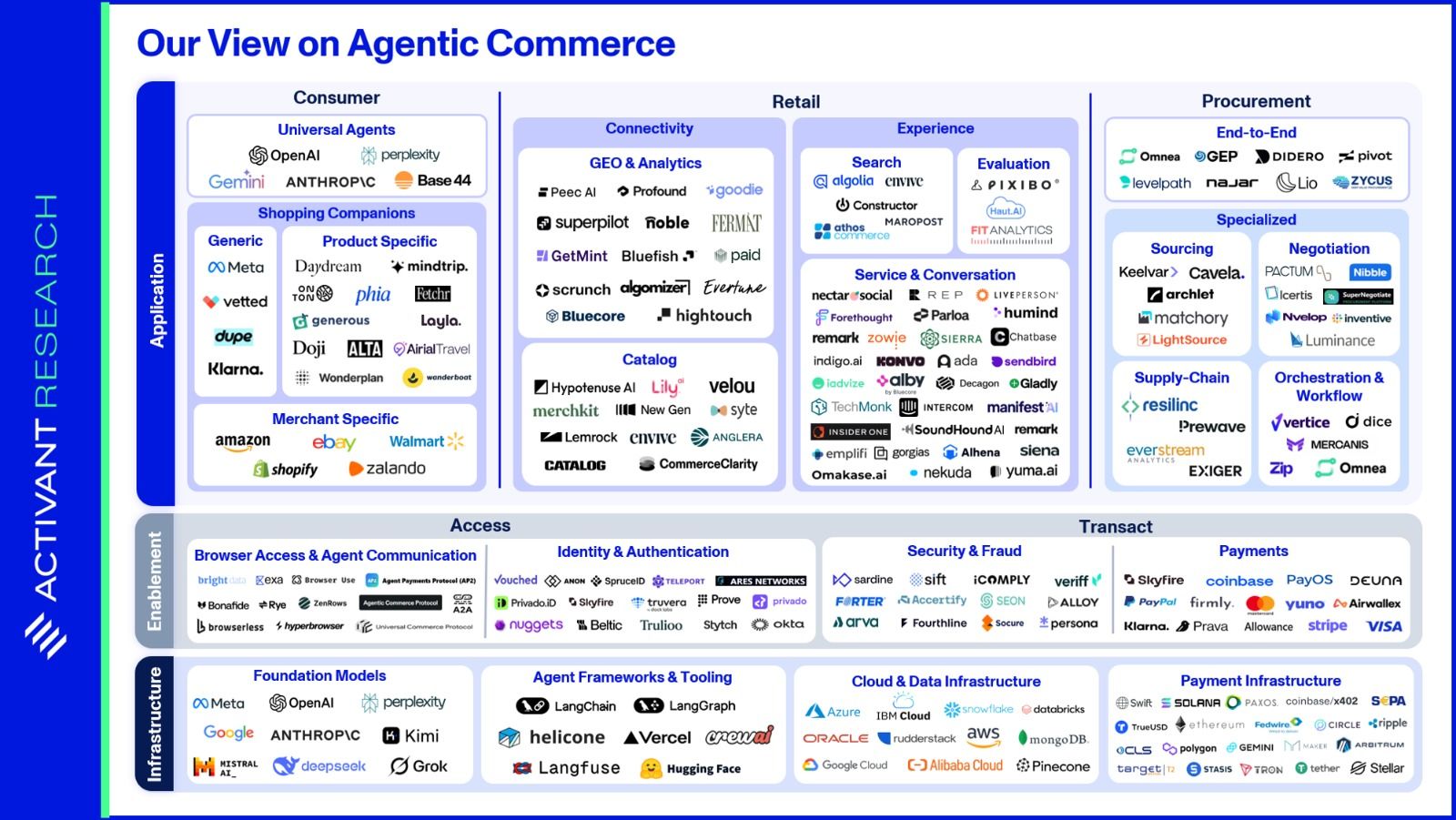
I transcribed every box and checked the labels against current first-party sources. The result is 219 placements and 209 distinct map labels. Ten labels repeat. Some are companies, but others are products, protocols, blockchains, payment systems, and tokens. One logo, “Wondershoot,” did not resolve to a current official shopping or travel product I could verify.
The complete company-by-company research ledger is available as Markdown. It preserves every placement, links to the official source where one could be established, and calls out ambiguous, duplicated, or stale entries.
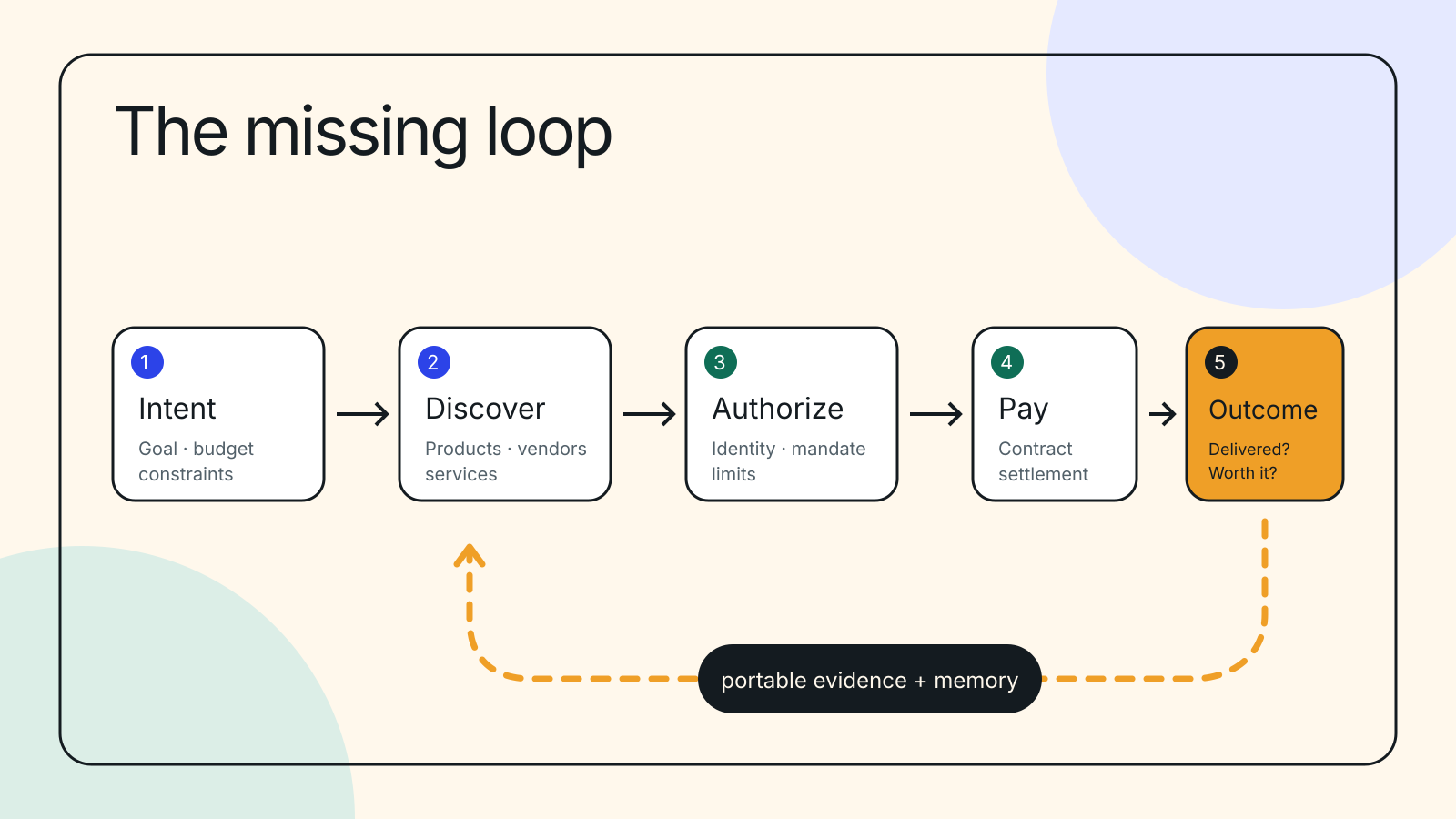
The larger finding is more interesting than the count: this market is building a very complete path to a transaction, but a much thinner path back from the outcome. The crowded map explains how an agent discovers, understands, authorizes, and pays. It says much less about how the next agent learns whether the thing was delivered or worth buying again.
The landscape is already wider than shopping
The top of the slide is organized around three application markets:
Consumer contains the assistants people will ask to shop: OpenAI, Perplexity, Gemini, Anthropic, and more specialized agents for fashion, gifting, and travel. Daydream offers conversational fashion shopping. Vetted synthesizes product research. Layla and Airial turn a travel brief into an itinerary and bookable options.
Retail contains the systems a merchant uses to become legible and persuasive to those agents. That includes generative-engine visibility, product-data enrichment, search, size and skin evaluation, conversational selling, and customer service. Anglera turns incomplete supplier data into sourced, structured product intelligence. Constructor and Algolia handle search and discovery. Sierra, Decagon, Intercom, and many others handle the conversation after an agent or person arrives.
Procurement is the enterprise version of the same idea, except the purchase often has no finished SKU. Didero operates supplier communication and physical-spend workflows. Lio describes agents that classify requests, identify suppliers, collect quotes, enforce policy, route approvals, negotiate, and execute purchases. Pactum focuses on autonomous supplier negotiation.
That procurement column may be the best preview of mature agentic commerce. Retail shopping usually begins with an existing catalog. Procurement begins with an objective and creates the specification, offer, contract, and acceptance boundary along the way.
- Find item
- Compare offer
- Pay
- Receive
- Define need
- Source vendors
- Collect bids
- Negotiate
- Approve
- Accept work
There is a buyer stack and a seller stack
Many market maps group products by feature. A more useful split is by principal: whose interests does the software represent?
Buyer side
Universal agents, shopping companions, sourcing, negotiation, and procurement.
Commercial boundary
Offer, mandate, contract, payment, delivery, and recourse.
Seller side
Catalog, search, merchandising, product advice, service, and merchant agents.
This reveals differences hidden by the slide's categories. Pactum negotiates for procurement teams. Inventive, which the slide also puts under negotiation, primarily helps sellers answer RFPs and security questionnaires. Both touch negotiation, but they sit on opposite sides of the table.
The same distinction applies in consumer commerce. A shopping companion may optimize for the buyer's preferences and budget. A merchant's conversational agent optimizes for fit, conversion, and customer lifetime value. Neither is automatically dishonest. They simply represent different principals, which means the commercial boundary has to make identity, authority, offer terms, and recourse explicit.
The real race is to make intent executable
The enablement layer is where this becomes more than a chat interface.
Browser Use, Browserless, Hyperbrowser, Bright Data, and Rye help agents reach and operate the existing web. Protocols take the cooperative path: ACP defines agent-to-merchant checkout, UCP covers commerce interactions, AP2 carries payment mandates, and A2A handles communication between agents.
Browser route
Operate the site's existing human interface.
Protocol route
Exchange structured commerce messages.
Identity and payment vendors then turn a person's broad request into narrow machine authority. Teleport gives agents short-lived infrastructure identities. Privado ID links agents to verifiable identity and attestations. Skyfire combines agent identity, authority, wallets, and payments. Allowance and Prava give an agent scoped payment credentials instead of exposing a person's real card.
The recurring object is a mandate:
This agent, acting for this principal, may spend up to this amount, at this merchant, before this deadline, for this purpose.
Once that object is verifiable, the agent can move from recommending to acting without receiving unlimited access to a human's identity, account, or money.
The map mixes markets with plumbing
The slide is useful as an inventory, but its taxonomy should not be treated as ground truth.
- Paid appears under GEO and analytics even though it sells pricing, billing, and margin infrastructure for agents.
- Base44 appears as a universal agent, but it is primarily an AI app builder.
- “Privado.ID” and “Privado” are two placements for the same identity product family.
- “TARGET2” is a legacy name. The Eurosystem replaced it with T2 in March 2023.
- “Gemini” means Google's assistant in the consumer box and the cryptocurrency company in payment infrastructure.
- The payment-infrastructure box mixes regulated systems such as Fedwire, messaging networks such as Swift, public blockchains such as Ethereum, and tokens such as TrueUSD.
That mixing is itself informative. Agentic commerce is not becoming a clean, vertically integrated category. It is becoming a composition of probabilistic agents and deterministic systems: models decide what to try; identity and policy constrain the action; payment systems settle; merchant and logistics systems fulfill.
The missing category is outcome memory
The slide has many ways to get an agent to the payment. It has fraud tools to judge whether the transaction looks legitimate, identity systems to say who is acting, and catalog systems to say what the merchant offered.
But a payment receipt only proves that money moved. It does not prove that an API returned the promised data, a package arrived intact, a recruiter found a qualified candidate, or a consultant delivered work that passed the acceptance test.
Intent
Goal and bounds
Choice
Offer and evidence
Authority
Identity and limits
Transaction
Contract and payment
Outcome
Delivery and memory
This is why reviews and receipts matter more as agents become buyers. The useful record is not a generic star rating. It links:
- what the buyer asked for;
- what authority the agent received;
- what offer or contract it accepted;
- what evidence came back; and
- which provider, intermediary, or integration actually succeeded or failed.
That record should be readable by the next agent through plain HTTP, attributable to a verified principal, and specific enough to route around a repeated failure. Private receipts can remain private while public proof labels and cryptographic commitments establish that evidence exists.
What I would watch next
The 209 labels make this look like a market-share race. I think the more important questions are architectural:
Will cooperative protocols beat browser execution? Probably neither completely. Protocols can make willing merchants reliable and fast. Browser infrastructure will remain the compatibility layer for the rest of the web.
Who owns the mandate? A model provider, wallet, card network, identity company, or buyer may all want to be the source of delegated authority. Portability will determine whether users can change agents without rebuilding trust and payment setup.
Does procurement split from retail? The underlying loop is the same, but procurement needs policy, comparable bids, negotiation, approval, contracts, milestones, and acceptance evidence. It is a deeper workflow than product checkout.
Where does performance history live? Catalog claims belong to the merchant and transaction records belong to payment systems. A portable outcome record needs to remain useful across both.
Agentic commerce lets software take a bounded objective through a commercial process and improve the next attempt. The current landscape is close to completing the first half. The market that remembers what happened completes the loop.
This extends the argument in What Is the Actual Point of Agentic Commerce? and the service-procurement model in Agentic Commerce Is Becoming a Services Market.